What Is E-Ink?
E-Ink, or electronic ink, mimics the appearance of traditional ink on paper. This technology offers a unique reading experience. It is used in devices like e-readers. These include popular models such as Amazon Kindle and Kobo. E-Ink is known for its energy efficiency and readability.
The Science Behind E-Ink
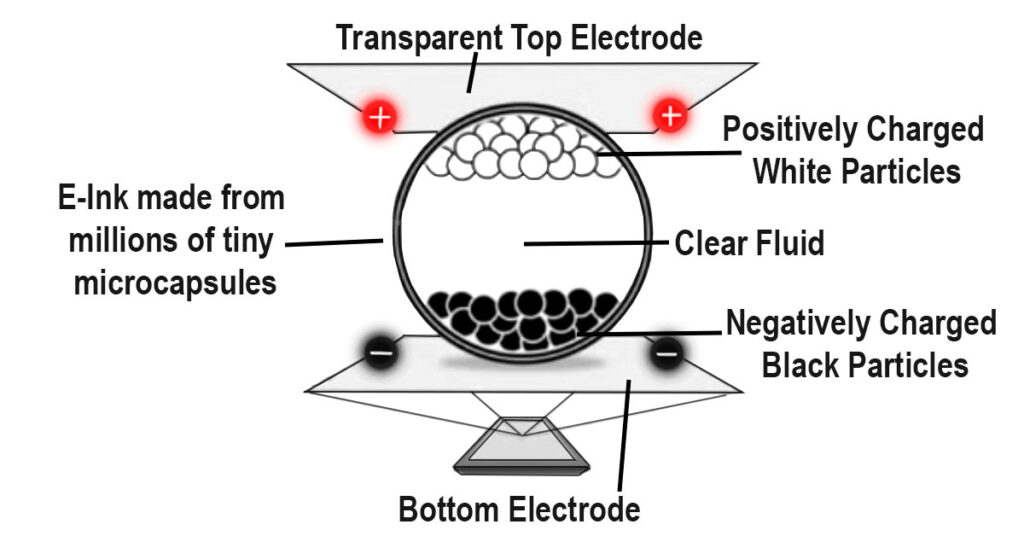
E-Ink displays consist of tiny capsules. Each capsule contains black and white particles suspended in a clear fluid. The particles have electric charges:
- Black particles: Negatively charged
- White particles: Positively charged
When electricity is applied, the particles move:
- Negative charge: Pushes black particles to the top
- Positive charge: Brings white particles to the surface
This movement forms text or images on the display.
How E-Ink Saves Energy
E-Ink technology is efficient in energy use. It consumes power only when the image changes. When reading a static page, it uses virtually no energy. This leads to impressive battery life in e-readers. Many can last weeks on a single charge.
In contrast, LCD and LED screens require constant power. They use backlighting, which drains battery life quickly. E-Ink displays are a better choice for avid readers.
A Brief History of E-Ink
E-Ink was developed in 1996 by MIT scientists. They created a company in 1997 that holds the technology’s patent. The technology gained popularity with the rise of e-books. Major retailers like Amazon and Kobo embraced E-Ink for their e-readers.
The first E-Ink display, Vizplex, launched in 2007. The E-Ink Pearl followed in 2010, achieving widespread adoption. Since then, innovations like E-Ink Carta and E-Ink Kaleido have emerged. These variations offer improved contrast and color displays.
Advantages of E-Ink
E-Ink displays have several notable advantages.
- First, they resemble paper, making them easier to read. Users enjoy less glare compared to LCD screens. This feature is especially useful in bright sunlight.
- Second, E-Ink is energy-efficient. It reduces the need for frequent charging.
- Third, the technology offers a high resolution, similar to LCD displays. Many E-Ink screens provide up to 171 pixels per inch.
- Moreover, E-Ink is comfortable for the eyes. It eliminates flicker, reducing eye strain. Users can read for extended periods without discomfort.
Applications of E-Ink Technology
E-Ink is not limited to e-readers. It finds use in various industries.
- Digital price tags in retail stores often use E-Ink. These tags can be updated wirelessly, saving time and resources.
- Smart home devices also employ E-Ink displays. They can show real-time information like weather updates.
- E-Ink is used for indoor signage and menu boards. It provides clear visibility, even from a distance.
- Hospitals use E-Ink for patient information displays. These signs can update automatically with relevant data.
Limitations of E-Ink
Despite its benefits, E-Ink has some drawbacks.
- Slower refresh rate: The refresh rate is slower compared to LCD screens. Users may notice delays when changing images.
- Limited color options: Traditionally displays mainly in black and white, though color options are emerging
The Future of E-Ink
E-Ink technology continues to evolve. Advanced Color ePaper (ACeP) introduces vibrant colors while maintaining low power usage. This innovation could transform reading and digital displays further.
In conclusion, E-Ink technology offers a compelling reading experience. It combines energy efficiency, eye comfort, and a paper-like appearance. As it evolves, E-Ink will likely play a significant role in our digital lives.
If You Are Interested, you can check out in: